THE LEGACY OF PRINCE MANGOSUTHU BUTHELEZI by THEMBA NZIMANDE
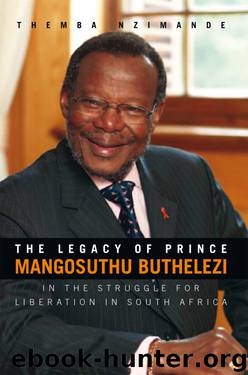
Author:THEMBA NZIMANDE [NZIMANDE, THEMBA]
Language: eng
Format: epub
Publisher: Xlibris Corporation
Published: 0101-01-01T05:00:00+00:00
There was no organisation like Inkatha. It was used to inspire the youth to pride themselves of their own indigenous culture and political idiom. It was therefore a sound and highly relevant model.
What was the situation with other disenfranchised racial groups in the country? Thompson and Prior paint the following picture about the Coloured people and South Africans of Indian descent.
Coloured and Asian councils
When the National Party came to power in 1948, it had three immediate objectives with regard to the Coloured population. The first was to segregate the Coloured people biologically, which it did by prohibiting Coloured/white intermarriage and sexual relations. (Prohibition of Mixed Marriages Act No. 55, of 1949).
The second was to segregate Coloured residential areas, which it achieved under the Group Areas Act of 1951. This act resulted in the shifting of thousands of Coloured families from areas which became defined as ‘white’. It bore unequally on the Coloured and the white communities: the former were moved from desirable areas close to the city of Cape Town to the windswept, sandy parts of the Cape Flats; whereas whites gained control of the areas thus lost to Coloureds.
The third objective was to segregate the Coloured people politically… this process was completed in 1968, when they were deprived of any say in the composition of parliament and of the right to be members of the same political parties as whites. Instead, the government created a Coloured Persons Representative Council to be elected by Coloured people throughout the Republic on the basis of general adult franchise, and partially appointed by the government. (Prohibition of Political Interference Act, 1968 and the Separate Representation of Voters Amendment Act, 1968; Coloured Persons Representative Council Act, 1968). This legislation provoked a crisis in the Coloured population. Many of them had hoped that they would not experience the full impact of apartheid and that the whites would eventually incorporate them into their own dominant community. The 1968 legislation destroyed this illusion.[79]
Download
This site does not store any files on its server. We only index and link to content provided by other sites. Please contact the content providers to delete copyright contents if any and email us, we'll remove relevant links or contents immediately.
Waking Up in Heaven: A True Story of Brokenness, Heaven, and Life Again by McVea Crystal & Tresniowski Alex(37811)
Empire of the Sikhs by Patwant Singh(23086)
We're Going to Need More Wine by Gabrielle Union(19046)
Hans Sturm: A Soldier's Odyssey on the Eastern Front by Gordon Williamson(18592)
Leonardo da Vinci by Walter Isaacson(13336)
The Radium Girls by Kate Moore(12028)
Tools of Titans by Timothy Ferriss(8396)
Educated by Tara Westover(8054)
How to Be a Bawse: A Guide to Conquering Life by Lilly Singh(7486)
Permanent Record by Edward Snowden(5847)
The Last Black Unicorn by Tiffany Haddish(5636)
The Rise and Fall of Senator Joe McCarthy by James Cross Giblin(5280)
Promise Me, Dad by Joe Biden(5153)
The Wind in My Hair by Masih Alinejad(5095)
A Higher Loyalty: Truth, Lies, and Leadership by James Comey(4964)
The Crown by Robert Lacey(4817)
The Iron Duke by The Iron Duke(4356)
Joan of Arc by Mary Gordon(4110)
Stalin by Stephen Kotkin(3966)
